




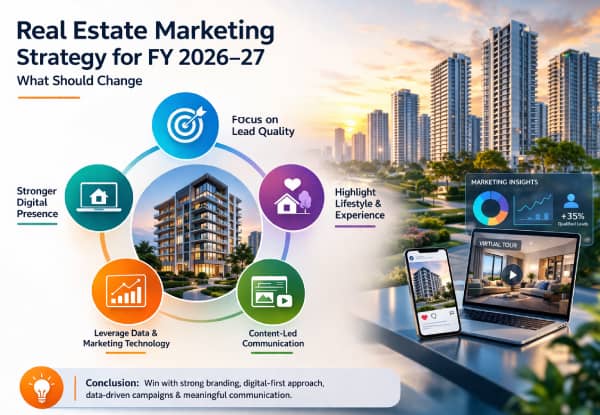
Real Estate Marketing Strategy for FY 2026–27: What Should Change
The
traditional marketing methods of real estate marketing are no longer sufficient
to drive consistent sales. Over the past few years, the real estate industry
has entered a new phase where buyer behavior has evolved, digital platforms are
the primary discovery channel and competition among developers has intensified
across both, metro and emerging micro-markets.
With
FY 2026-27 underway, developers and the real estate brands should plan better
and rethink their marketing strategies to stay competitive and relevant in
today’s era. The focus must shift from simple promotions to a more structured
property marketing strategy that is strategic, data driven and experience-led.
From Lead Generation to Lead Quality
In
the FY 2026-27, the focus should be on attracting the right buyers instead of
just more buyers. This means that the developers need to identify the target
audience clearly and design campaigns specially for them.
The
leads can include first time homebuyers, investors, millennials or NRIs. For a
long time, these evolving property marketing trends focused on generating a
high volume of leads but they have now
realised that high lead volume doesn’t always convert to sales.
Performance
marketing, behavioural targeting and refined audience segmentation will play a
crucial role in improving lead quality and reducing customer acquisition costs
Stronger Digital Presence Is No Longer Optional
The
online presence of marketers is no longer an option because today, homebuyers
begin their search online. Most of their research for homebuying happens online
whether it is about price trends, location advantages or project reviews.
Thus,
this means that developers will benefit from a stronger digital ecosystem,
whether it is active social media presence, search engine visibility, property
portal optimisation and engaging video content such as walkthroughs or virtual
tours.
This
means that when developers invest in a strong property marketing strategy,
projects are visible during the early stages of the buyer journey and it
significantly improves chances of conversion.
Highlighting Lifestyle, Not Just Specifications
When
it comes to marketing campaigns, the focus should not be only on configuration
details like pricing and amenities or carpet area alone. No doubt, these
aspects are important but today’s buyers are also interested in a lifestyle
offered by the project.
Modern
real estate marketing should also focus on amenities and lifestyle prospects
such as community living, wellness spaces, or co-working areas within the
community.
This
reflects broader property marketing trends and means that, by focusing on
lifestyle factors, the developers should also be willing to communicate how
these factors enhance everyday life of the buyers.
Leveraging Data And Marketing Technology:
In
the future, marketing technologies will play a larger role in real estate
development. Developers who leverage analytical tools and marketing platforms
will have a significant advantage.
Because
these technologies will help track the buyer behaviour, measure campaign
performance and improve marketing strategies. Property marketing strategy for
developers will improve with better use of data, marketing teams can refine
campaigns and focus on budget effective action.
This
shift will be data-driven and will be a major decision making factor for
successful real estate marketing in FY 2026-27.
Content-led
Communication Will Dominate:
For
real estate marketing, content is becoming the most powerful tool. Information
blogs, market insights, location guides and investment related content make
developers the trusted industry voices due to effective marketing.
This
is where real estate content marketing becomes highly effective. Buyers today
want more than just promotional messaging. Buyers are likely to engage with
developers who provide valuable project insights rather than just selling
techniques.
This
helps attract organic traffic and build long-term engagement with potential
customers.
Conclusion:
Real
estate advertising is evolving rapidly and marketers who rely solely on
traditional advertising or short-term promotions may struggle to stand out in
the increasingly competitive environment.
Therefore,
in the financial year 2026-27, a future focused property marketing strategy and
successful real estate marketing will depend on strong branding, digital-first
strategies, data-driven campaigns and other meaningful communication with the
buyers.